



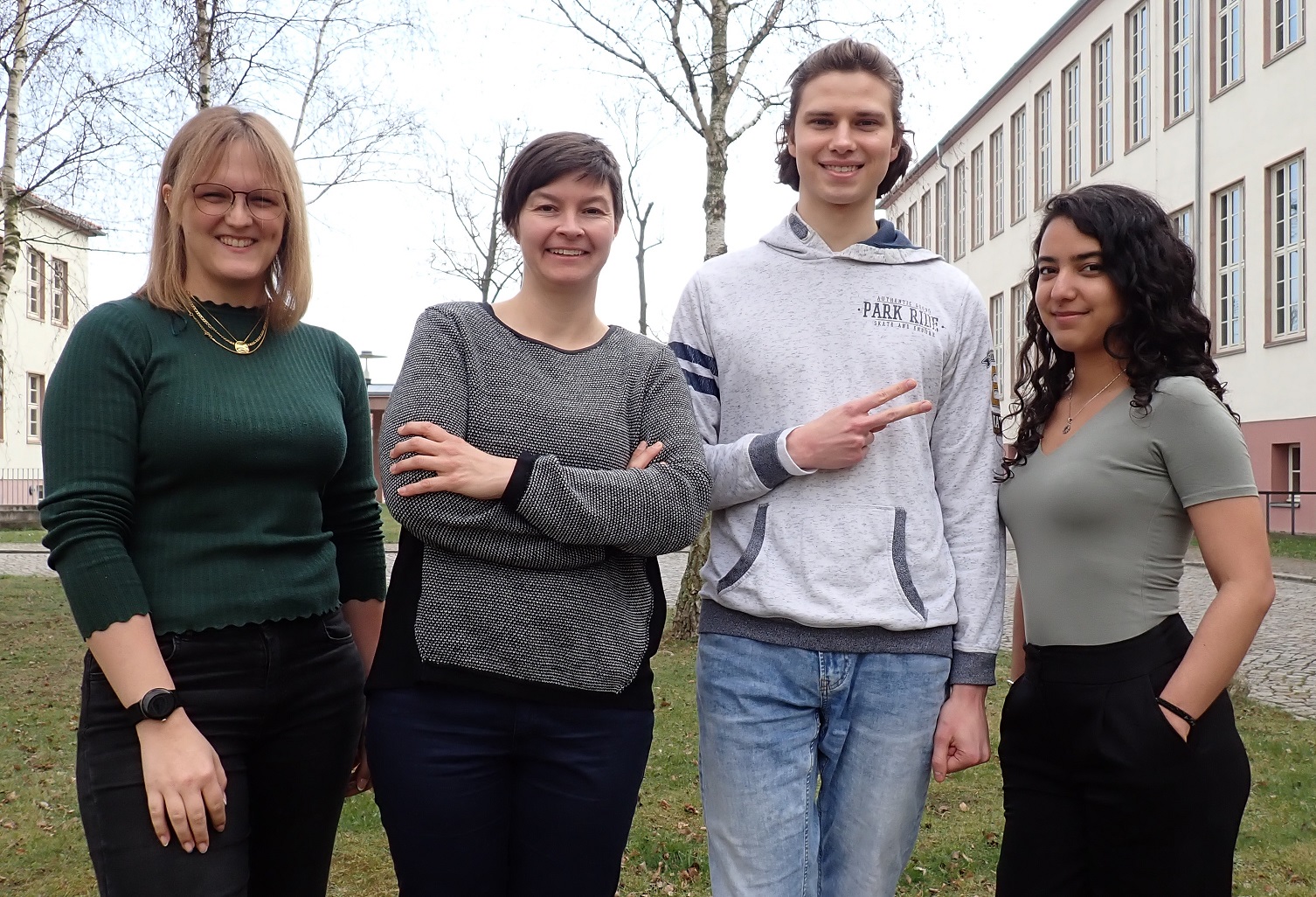

Hoernke CV
Dr. Maria Hoernke studied chemistry at the Martin-Luther-Universität in Halle (Germany) and at Universidad de Burgos (Spain). Maria performed her PhD project at the MPI in Potsdam and specialized in bio-physical chemistry and biophysics and obtained her habilitation in pharmaceutics at Freiburg University.
Her Diploma thesis focused on the interactions of peptides with lipid model membranes and was carried out in 2007/2008 in Halle (S.). For her PhD project, Maria moved to the interfaces department of Max-Planck-Institute of Colloids and Interfaces in Potsdam (Germany) to study the impact of interfaces on amyloid formation of peptides. After receiving her PhD in 2012, she joined the Theory & Bio-Systems department of the same MPI to complement the project with molecular dynamics simulations as a Postdoc. In 2013, Maria joined Göteborgs Universitet (Sweden). She won a Marie Curie IEF fellowship in order to use time resolved X-ray solution scattering to study conformational changes in photoreceptor proteins. She also investigated structural changes in membrane associated proteins by infrared spectroscopy. 2015 Maria moved to Freiburg to support establishing the Heerklotz group. The Daimler and Benz foundation contributed funding and since 2019 Maria raises funding for her own team from the DFG, and more recently also by the European Union together with the state of Saxony-Anhalt. In 2023, the team got split to Freiburg and Halle University and is now fully located at Halle University. Maria achieved venia legendi in 2024.
Maria was speaker of the section 'Membrane Biophysics' of Deutsche Gesellschaft für Biophysik e.V.
https://www.dgfb.org/de/ueber-dgfb/sektion-ii-membran-biophysik
Research topics
- Biophysics of lipid membranes
- Conformational changes and orientation of membrane‑bound, surface‑bound and soluble proteins or peptides
- Interactions of polymers or peptides with membranes
- Permeabilization of lipid membranes, selectivity
- Drug delivery across membranes
- Archaeal membranes
- Self‑assembly of designer proteins
- Surface‑sensitive biophysical methods
Methods
- Fluorescence spectroscopy (TCSPC, FRET, etc.)
- Infrared spectroscopy (including infrared reflection‑absorption spectroscopy)
- Microcalorimetry (differential scanning calorimetry, isothermal titration calorimetry)
- Monolayer methods
- X‑ray scattering (SAXS/WAXS, time‑resolved X‑ray scattering, grazing incidence X-ray diffraction, reflectometry, total reflection X-ray fluorescence)
- UV/Vis spectroscopy
- Circular dichroism
- Dynamic light scattering